Economics as a science
The nature of Economics
Economics is a social science because it studies an aspect of human behaviour: how people attempt to provide for their material needs.
We study Economics as a discipline because of relative scarcity. If factors of production and goods and services were freely available, Economics as a discipline would not have been necessary. The value of studying Economics is that a person with knowledge of Economics can determine their place in the national economy and which economic factors determine their welfare.
Positive and normative approaches
It is not about being positive or negative!
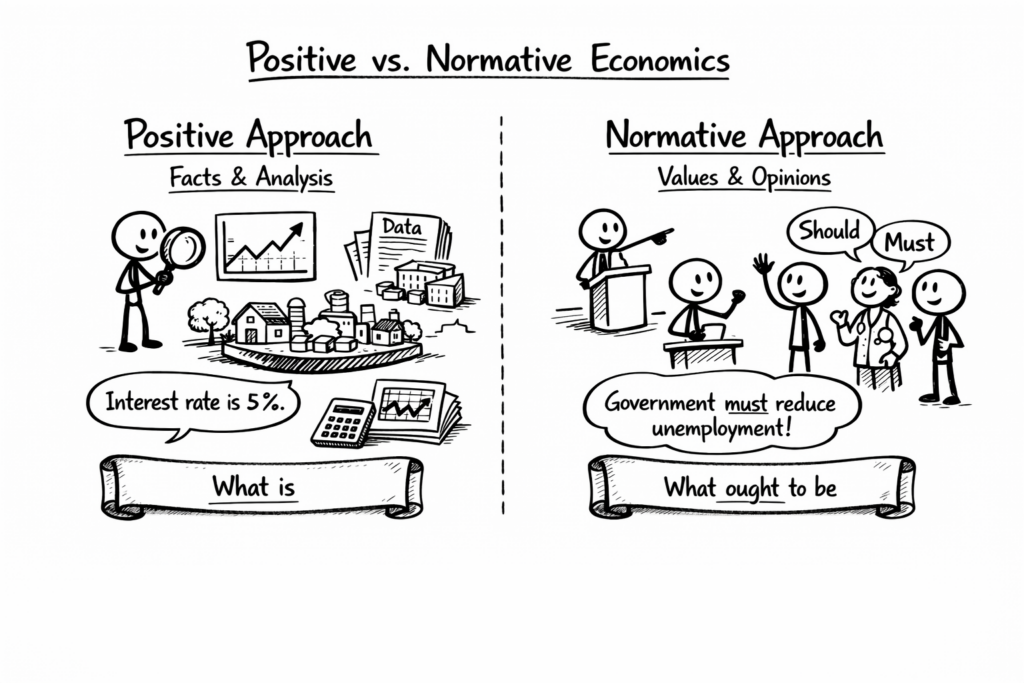
A positive approach is to study things as they are. It is about proving things right or wrong by looking at the data, for example, “the interest rate for savings accounts is 5%”. There are no value judgements (right/wrong, good/bad) involved. Economists use theoretical models and empirical analysis.
A normative approach makes value judgements about what economic outcomes should or should not be. A normative argument can be debated, but it cannot be resolved by looking at the facts. Normative statements contain words such as “should” or “must”, for example “unemployment should be the government’s first priority”. This is why Economics has different schools of thought (that you don’t find in Accounting).
Theories and models
An economy is a complex organisation of a large number of economic activities that are interrelated. To understand economic reality, it must be simplified. By concentrating only on certain components and their interrelationships, the complex reality is simplified and made manageable. The simplified reality is stated in the form of a theory, also called economic laws, for example, the law of demand, which states that if the price of a product increases, people will buy less of it.
Economic theory has the following three objectives, namely:
- to explain the relationships between the different components of economic reality,
- to predict what will happen if there is a change, and
- to serve as a basis for decisions on economic policy.
A model is a formal representation of an economic theory. Economic theories are expressed as models in the following ways: through description, numerical tables, symbols and equations, illustrations and diagrams.
Economic models (laws) are only provisional. They are not absolute laws that apply under all circumstances. An economic law can only state what an aspect of economic behaviour will be under certain circumstances. The law of demand can only state that consumers will generally buy less of a product if the price increases. There may be exceptions.
The scientific method
Economic phenomena are investigated according to the scientific method. When economic phenomena are investigated, the following steps are followed:
(a) Formulation of the problem and the research question:
- The problem to be investigated is formulated and stated in the form of a question, for example, “what is the relationship between fuel prices and motor vehicle sales?”
- A preliminary answer to the research question is formulated, for example, “there is no relationship between fuel prices and motor vehicle sales”.
- The preliminary answer forms the hypothesis that must be proved right or wrong.
(b) Collection of data:
- Data related to the research question is collected, for example, fuel prices and motor vehicle sales for a period.
(c) Organisation and interpretation of the data:
- The data is organised in tables, graphs or diagrams to make it more understandable.
- Inferences and conclusions are drawn from the data, for example, “when fuel prices increase, motor vehicle sales decrease”.
(d) Explanation of the results:
- The reasons for the relationship between the variables and the implications thereof are set out, for example, “higher fuel prices reduce disposable income and therefore motor vehicle sales decrease”.