The participants
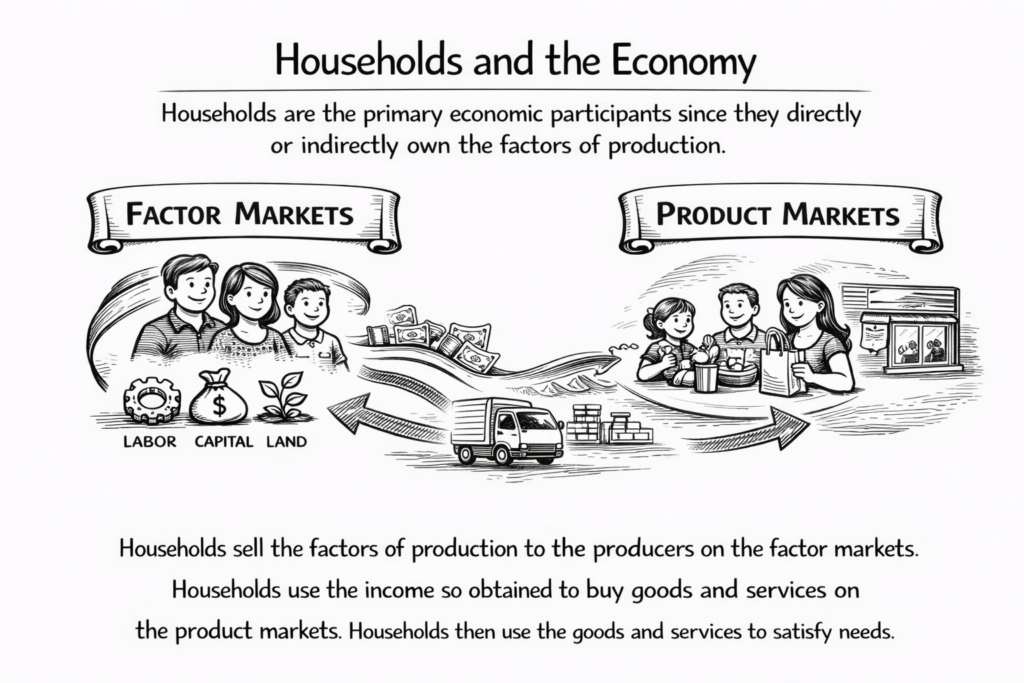
Households
Households consist of people who live together, who share an income and who jointly make economic decisions (also called consumers).
Households are the primary economic participants since they directly or indirectly own the factors of production. Households sell the factors of production to the producers on the factor markets.
Households use the income so obtained to buy goods and services on the product markets. Households then use the goods and services to satisfy their needs.
Producers
Producers are organisations that use factors of production to produce goods and services (also called businesses or firms).
Producers buy the factors of production from households on the factor markets. Producers then produce goods and services and sell them to households, the government and the foreign sector on the product markets.
Producers aim to make maximum profit.
Producers and consumers are the same people who act in these two capacities.
The Government
The government consists of all politicians, agencies and institutions of local, provincial and central government (also called the state or the public sector). The government buys factors of production and goods and services and produces government services to provide for the collective needs of the community. The government also provides money to households and producers in the form of transfers and subsidies.
Government expenditure is financed by levying taxes on households and producers.
The government also provides the legal framework within which the economy functions.
The Foreign Sector
The foreign sector consists of all persons and institutions involved in international transactions.
International transactions consist of imports and exports of goods, services and money between countries.
- Imports are the purchase of goods and services produced in other countries.
- Exports are the sale of locally produced goods and services to foreign countries.
Surplus products are exported; shortages are imported.