Production
Production involves combining the factors of production in a production process to produce goods and services.
The factors of production are the four production factors, namely:
- Capital goods: Capital goods are goods used for the production of other goods, for example tools, machinery, buildings, vehicles, etc.
- Labour: Labour is the physical and mental effort of workers.
- Natural resources: Natural resources are the gifts of nature that can be used in production, for example soil, minerals, water, etc.
- Entrepreneurship: Entrepreneurship is the organisational ability to combine the natural resources, labour and capital goods in a production process.
The products that are produced are basically classified into goods and services:
Goods: Goods are tangible man-made items with their own existence, for example food, houses, books, cars, etc.
Goods are divided into consumer goods and capital goods.
Consumer goods: These are goods used directly by consumers for need satisfaction. They are divided into three components:
- Non-durable consumer goods: These are goods such as food and water that are no longer available after use.
- Semi-durable consumer goods: These are goods that can be used several times in succession but must be replaced after a time, such as shoes and clothing.
- Durable consumer goods: These are goods that can be used repeatedly over a long period, for example a radio, cutlery, refrigerators, etc.
Capital goods: These are goods used to produce consumer goods and services and other capital goods, for example tools, machinery, buildings, vehicles, etc.
Services: Services are useful functions performed by individuals and institutions, such as medical treatment, education and legal advice. Services do not exist in physical form.
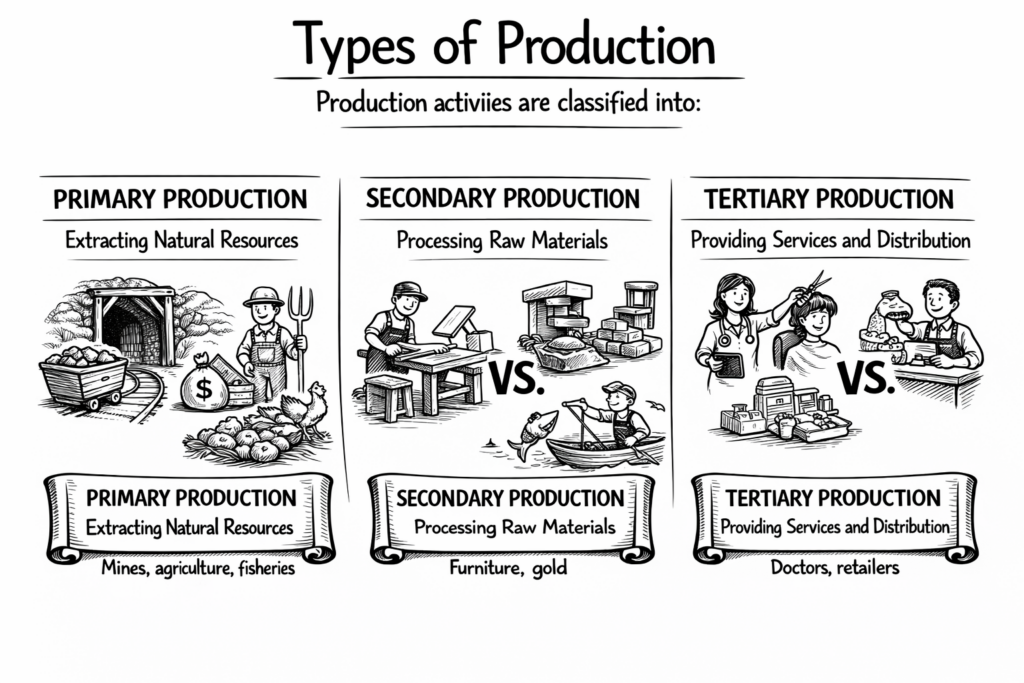
Production activities are classified into three main groups:
- Primary production: Primary industries extract and collect natural resources, for example mines, agriculture and fisheries.
- Secondary production: Secondary industries process the extracted natural resources into goods, for example furniture from wood, gold from gold ore and maize meal from maize kernels.
- Tertiary production: The distribution of products by wholesalers and retailers and the provision of personal services and commercial services such as doctors, hairdressers and property insurance.
Specialisation in production is when there is concentration on specific tasks and products in a production process. It occurs as labour specialisation and product specialisation respectively:
- Labour specialisation is when workers only participate in a small part of the production process, for example a worker in the building industry who only does painting.
- Product specialisation is when each producer only produces part of the final product, for example a company that only produces bricks for the building industry.
Specialisation in production leads to greater volumes of production and more welfare for a community.