Exchange (Trade)
As a result of labour specialisation and product specialisation, producers produce a surplus of the product they produce. These surpluses must be exchanged on markets with the surplus products of other businesses, so that businesses and consumers can acquire the goods and services they need.
A market is any place or circumstance where buyers and sellers of goods and services can come into contact with each other to conclude transactions. It can be a physical place like a shop, or it can be negotiation over the phone, email, etc.
There are basically two groups of markets, namely the market for goods and services and the market for factors of production.
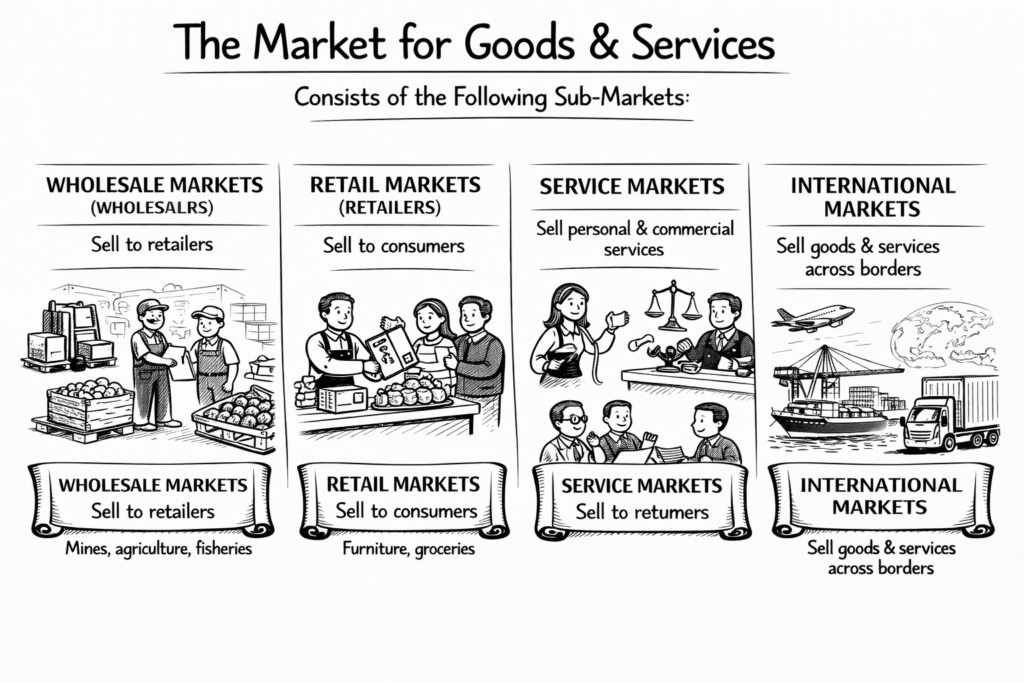
The market for goods and services consists of the following sub-markets:
- Wholesale markets (wholesalers). These are markets where wholesalers buy manufactured goods and fresh produce from producers and sell them to retailers.
- Retail markets (retailers). These are markets where retailers sell products purchased from wholesalers to consumers.
- Service markets. These are markets where commercial services and personal services are traded, for example legal services and medical services.
- International markets. These are markets where goods and services from different countries are traded.
The market for factors of production. These are the markets where the four factors of production are traded. There are separate markets for capital, labour, natural resources and entrepreneurship, respectively.
Geographically, a distinction can be made between local markets and international markets:
- Local markets are markets where products produced within national borders are traded.
- International markets are markets where products from different countries are traded.