The flows
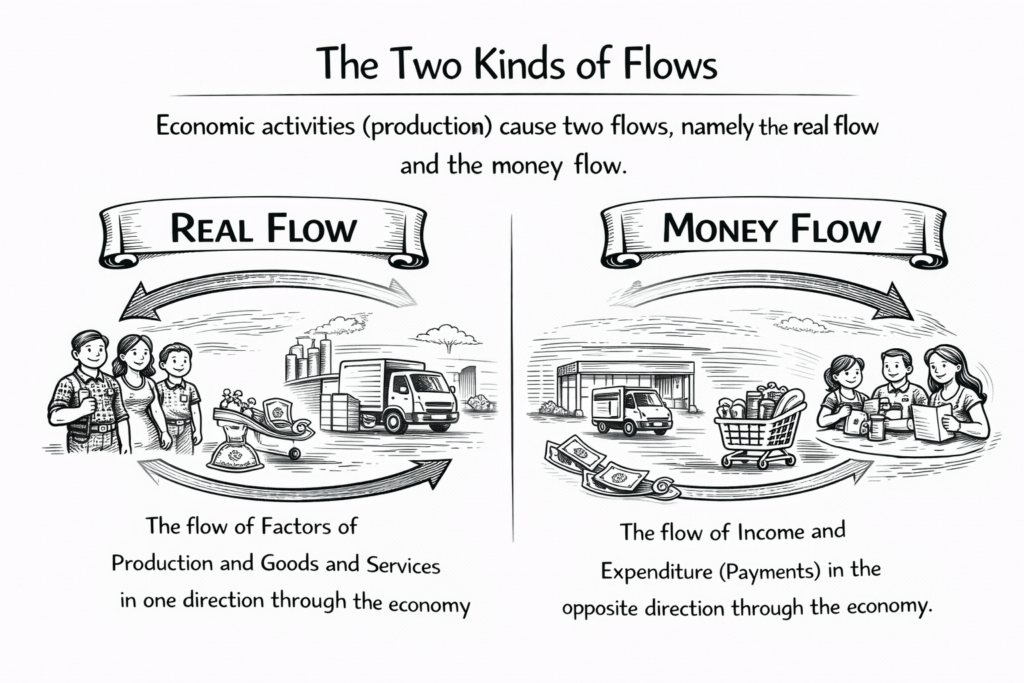
Economic activities (production) cause two flows, namely the real flow and the money flow.
- The real flow is the flow of factors of production and goods and services in one direction through the economy.
- The money flow is the flow of income and expenditure (payments) in the opposite direction through the economy.
The flows are facilitated by markets, because the factors of production and goods and services are exchanged on markets for money.
Households and producers generate the basic flows of income and expenditure.
The economic activities of the government and the foreign and financial sectors generate income and expenditure that can increase or decrease the money flow (there are injections and leakages that are explained in the next section).
Income and expenditure
- Households: receive income from the sale of factors of production and spend it on goods and services.
- Producers: receive income from the sale of products and spend it on factors of production.
- Government sector: receives income from taxation and spends it on government services, subsidies and transfers.
- Foreign sector: receives income from exports and spends it on imports.
The money flow
- The basic money flow is the flow of income and expenditure between households and producers.
- The money flows generated by the financial, foreign and government sector increase or decrease the basic money flow.
- The importance of the money flows is that the value of goods and services produced in the economy is derived from the money flow.
- There is a difference between money flows and stock. The flow of production, income and expenditure are variables measured over time. Stocks, such as assets, do not have a time dimension and can be measured at any time. Stocks can only change as a result of flows. Assets can only increase if more money flows to the business.