Choice
In their efforts to provide for as many of their material needs as possible, people face the following two dilemmas:
- Economic scarcity, namely that their material needs will always exceed the available goods and services (people cannot get all the goods and services they want); and
- that factors of production can be used for the production of one or another product (factors of production have different possible uses).
This situation forces the individual and the community to make economic choices. The individual must make consumption choices, namely on what types and quantities of goods and services to spend their income. The community must make production choices, namely:
- WHAT will be produced – what types of goods and services in what quantities will be produced in the community, for example, more cars or more aircraft.
- HOW will it be produced – what combinations of factors of production will be used in the production process, for example, more machinery or more manual labour.
- FOR WHOM will it be produced – who will get more or less of certain products, for example, whether sports stars will receive more remuneration than school principals.
The consumption choices of the individual and the production choices of the community are called the choice problem. Every economic choice has a cost, because if a certain product is acquired, there are other products that cannot be acquired, and the products not acquired form the economic cost of the product that was acquired. It cannot always be determined in advance whether the choice made will give the maximum benefit.
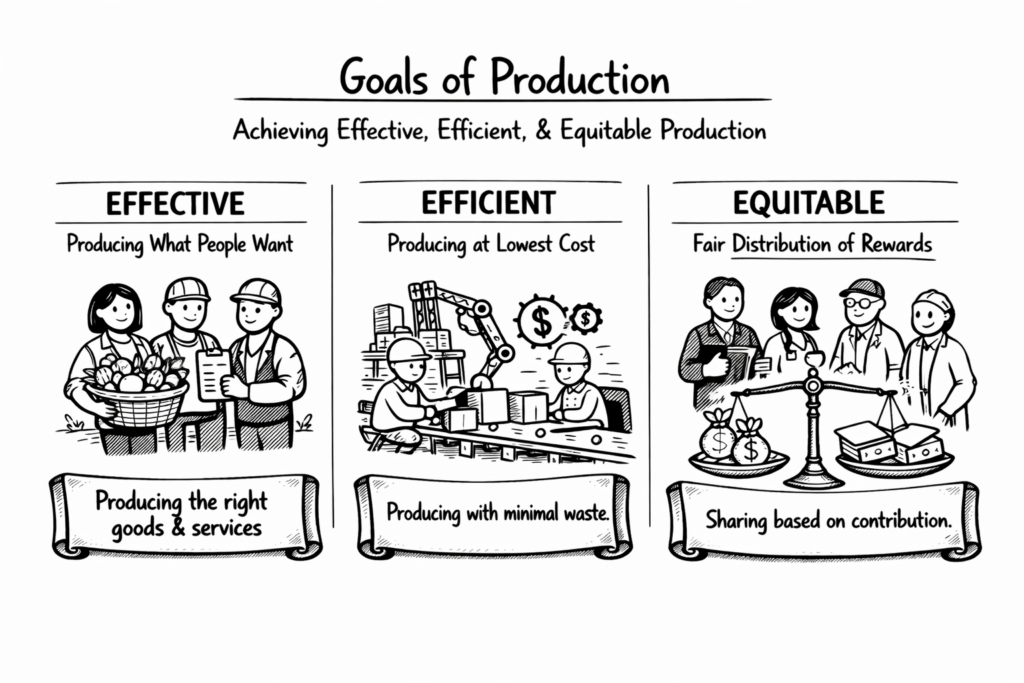
The production choices of the community must promote effective, efficient, and equitable production:
- Effective production means that the products the community wants will be produced.
- Efficient production means that products will be produced at the lowest possible cost.
- Equitable production means that each participant in production must receive that portion of production that corresponds to the importance and duration of their contribution.
There is usually a trade-off between efficient and equitable production. If equitable production is promoted, efficient production may suffer.