The definition of Economics
Definition: Economics is the discipline that studies how individuals, businesses and the government in an economy use the relatively scarce resources, or factors of production, to produce goods and services to satisfy their unlimited wants and needs.
Taking a subject for the first time is a bit like learning a new language. There are lots of new terms. The description of the study of Economics mentions wants, or needs, as well as factors of production.
“Needs” and “wants” are frequently used interchangeably, but you can say needs are the essentials: food, shelter, clothing, that you need to survive. Wants are all the other goods and services that you don’t strictly need, but really want. None of us are ever quite satisfied and need and want more stuff.
We get to “demand” in a lot more detail later, but it is important to note that a need or want only becomes demand that producers pay attention to when you can back it up with buying power. I want a new Land Cruiser Wagon, but I cannot pay for it, so Toyota is not producing one with me in mind.
When we consider the description: Economics is a social science that studies how individuals, businesses, and governments choose to use scarce resources to satisfy their unlimited wants and needs, the scarce resources are the factors of production: capital, labour, natural resources and entrepreneurship.
The factors of production are the inputs used to produce goods and services. Production requires physical labour and human capital. Capital is plant and machinery. Natural resources are all inputs that come from nature, from land and water to hard commodities (minerals, metals and oil) and soft commodities (maize etc.). Entrepreneurs pull everything together to supply the goods and services that consumers demand.
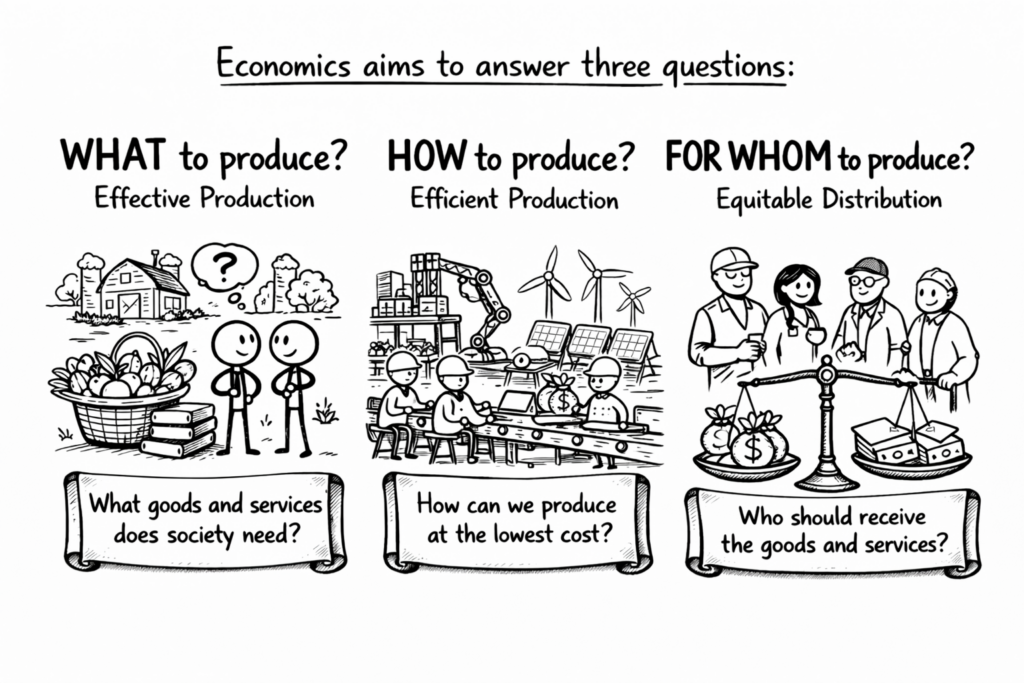
Economics is practised as a discipline to find effective, efficient, and equitable solutions to the three main economic problems. Economics aims to answer three questions:
- WHAT to produce. The types and quantities of goods and services that society wants must be produced (effective production).
- HOW to produce. Goods and services must be produced at the lowest possible cost (efficient production).
- FOR WHOM to produce. The distribution of goods and services must be equitable. Everyone who participated in production must receive what they deserve.
When striving for effective, efficient and equitable production, the material welfare of the members of the economy will increase (more material needs can be satisfied).