Scarcity
When we talk about scarcity, we need to start with human material needs.
Human material needs
Human material needs are people’s desire to acquire certain goods and services. The types and quantities of goods and services that people want to acquire are determined by their material needs.
People have individual and collective material needs:
- Individual material needs are the need for goods and services that a particular individual wants.
- Collective material needs are the need for certain goods and services where people live together in towns and cities, for example, water and refuse removal. These products can only be provided if a number of people share in the product.
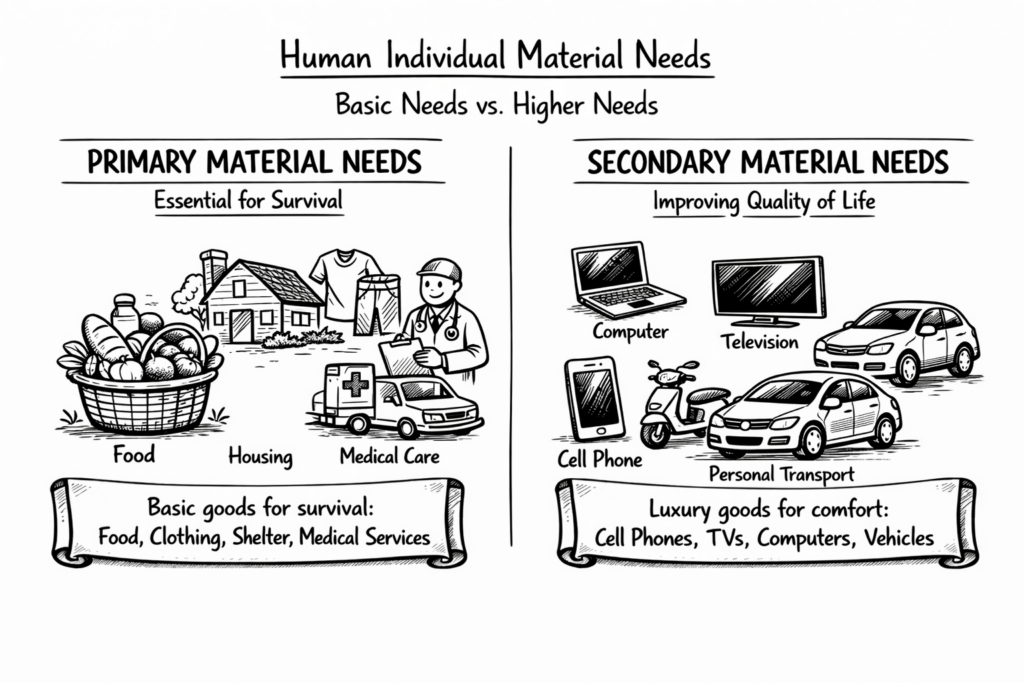
Human individual material needs consist of primary material needs and secondary material needs:
- Primary material needs are the need for goods and services that will ensure survival, namely food, clothing, housing and medical services.
- Secondary material needs are the need for goods and services that promote a high standard of living, such as computers, cell phones, television and personal transport.
Human material needs in general expand continuously. As soon as one need is satisfied, new needs arise in its place. People always have material needs, regardless of how many of their material needs have already been satisfied. Human material needs in general are therefore insatiable. Individual material needs can indeed be satisfied. The reason for the insatiability of material needs lies in human nature, namely that humans are dynamic beings who continuously strive for progress and gladly improve existing products and develop new products. The human economic motive is to satisfy as many material needs as possible. Humans satisfy their material needs by acquiring and using the products they need until the need is satisfied. Human material needs form the driving force behind production.
The scarcity problem
Economic scarcity is the permanent condition in any economy where there are not enough goods and services to provide for people’s needs. Goods and services are therefore “scarce” in relation to the need for them.
The reason for economic scarcity is that people’s need for goods and services expands and changes continuously and rapidly, to such an extent that goods and services cannot be produced fast enough to provide for the need.
There are two forms of scarcity, namely:
- Absolute scarcity. This is when someone has the means to acquire a product, but there is no stock of the product. For example, if someone has the money to buy a bag of oranges, but there are no oranges available, oranges are absolutely scarce in the economic sense.
- Relative scarcity (economic scarcity). This is when the product is abundantly available and people have the money to acquire it, but they cannot acquire as much of it as they would like to have. Relative scarcity is not scarcity in the normal sense of the word, namely, that there is not much of a product. There may well be a lot of the product, for example, shops full of clothing, but it is still less than what people want. The products are therefore relatively scarce in relation to the quantity that people want.
The reason for economic scarcity is that people’s need for goods and services expands and changes continuously and rapidly. There will therefore always be more needs for goods and services than there are goods and services in the economy. People’s material needs are therefore insatiable.
All goods and services are scarce in the economic sense because there is less of them than what people want. However, some goods and services are scarcer than others in relation to the intensity of the need for them.
Economic scarcity is not the same as poverty. All people experience economic scarcity. Rich people also have unsatisfied needs.
Economic scarcity is not the same as shortages of a product. Shortages of a product can be replenished by producing more of it, or by moving it to where it is needed. However, there will still be less of it than what people want.
The existence of economic scarcity gives rise to the necessity of economic choice-making, also called the choice problem.