Introduction
A country’s economy is a complex organisation of economic participants, markets and the flow of factors of production, goods, services and money through the economy.
The interaction between these components ensures that goods and services are produced and that households can satisfy their material needs with them.
The different participants are connected to each other through buying and selling transactions. Decisions to buy or sell form the basis of all economic activities in the country.
To explain how economic participants, markets and the flow of factors of production, goods, services and money through the economy are related, it is presented in the form of a diagram called the economic circular flow.
Households own the factor services and sell them to producers on the factor markets.
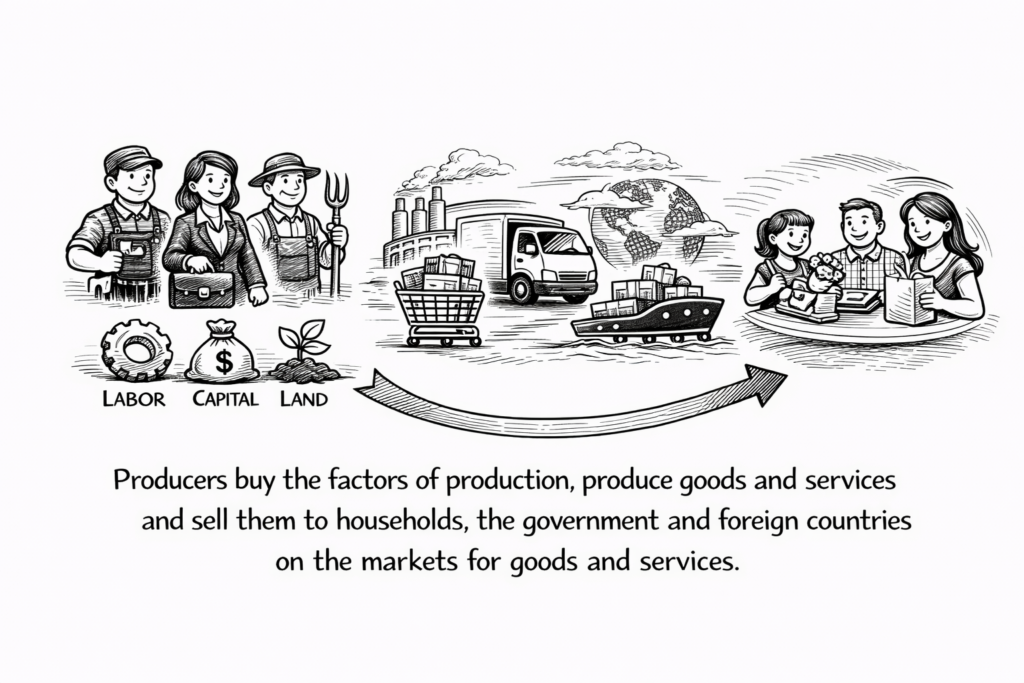
Producers buy the factors of production, produce goods and services and sell them to households, the government and foreign countries on the markets for goods and services.
Households buy the goods and services and consume them to satisfy material needs.
The government levies taxes on households and producers, buys factors of production and products and provides government services to households and producers.
The foreign sector imports and exports factors of production and goods and services, makes payments for imports and receives payments for exports.
The level of economic activity is measured by the level of the money flow.
The economy is in equilibrium when total income equals total expenditure.