Branches of Economics
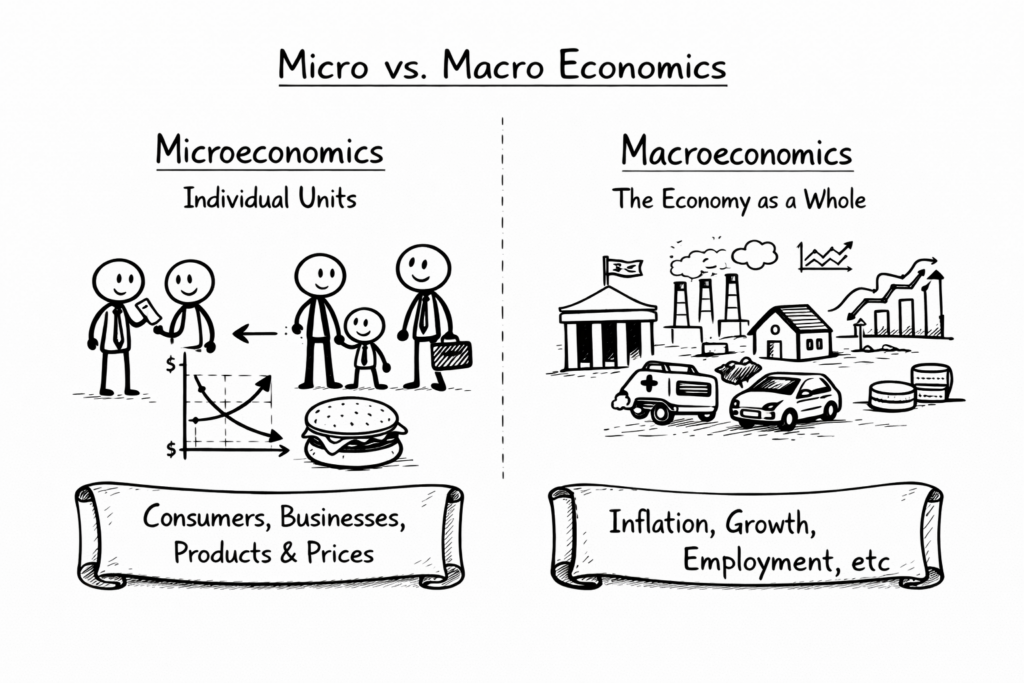
Economics is divided into two parts, namely, the study of individual units in an economy, called microeconomics, and the study of the totals of the individual units, called macroeconomics.
Microeconomics and macroeconomics sometimes overlap.
Microeconomics
Microeconomics is the study of the individual units in an economy, for example, consumers and businesses, or a single product or service. The economic aspects of these individual units involve the demand for a product, its supply and the price that is formed. Microeconomics, therefore, also studies price formation and is therefore also called price theory.
Microeconomics simplifies economic phenomena by concentrating on only one or two elements of the phenomenon and ignoring any other factors that may influence the phenomenon. This is called the “ceteris paribus” or “all other things being equal” principle. For example, if consumers’ demand for a product is examined, only the influence of consumers’ income on their demand for the product is examined. Other factors, such as the possible harmfulness of the product, are disregarded.
The usefulness of a microeconomic approach is that such an approach makes it possible to focus on a single component in the economy and determine the relationship between the different variables in the component.
Macroeconomics
Macroeconomics is the study of the totals of the microeconomic activities. This is, for example, the total demand and supply of a product in the economy, inflation, levels of employment for the entire economy, etc. Macroeconomics, therefore, studies the large units in the economy as a whole. Macroeconomics simplifies economic activities by combining them into a number of broad groups, such as total income, total expenditure, etc.
The usefulness of the macroeconomic approach is that it provides information about how the economy as a whole functions and performs.
Most of the time that you hear from an economist on the radio, or in the newspaper, the focus is on macro issues. The microeconomists do their work behind the scenes – for example, helping businesses to optimise their supply chain.
More branches of Economics
Economics has the following branches, each being a specialised area of study within the discipline of Economics:
- Monetary economics – the study of the role of money and financial institutions in the economy.
- Public economics – the study of the role of the government in the economy.
- International economics – the study of the flow of factors of production, goods and services and money between countries.
- Labour economics – the study of the sources and utilisation of labour and labour productivity.
- Development economics – the study of the development of underdeveloped economies and underdeveloped regions in an economy.
- Environmental economics – the study of environmental issues and the implications of certain environmental matters for the economy.
It is as Keynes said of the master economist: ‘No part of man’s nature or his institutions must lie entirely outside his regard.’ If you would like to see all sub-fields all exist (and with what you can combine your interest in Economics), have a look at the American Economic Association’s JEL guide. JEL stands for the Journal of Economic Literature, and the guide provides the official classification of all the different sub-fields. You will see that Economics has points of contact with, among others, agriculture, the financial world, health, law and many more.