Introduction
Economics is a social science that studies how individuals, businesses, and governments choose to use scarce resources to satisfy their unlimited wants and needs.
There are key elements to this definition: unlimited wants and needs, scarce resources, and necessary choice. All of it is studied through a social science lens. Before we unpack it, it is useful to take a step back.
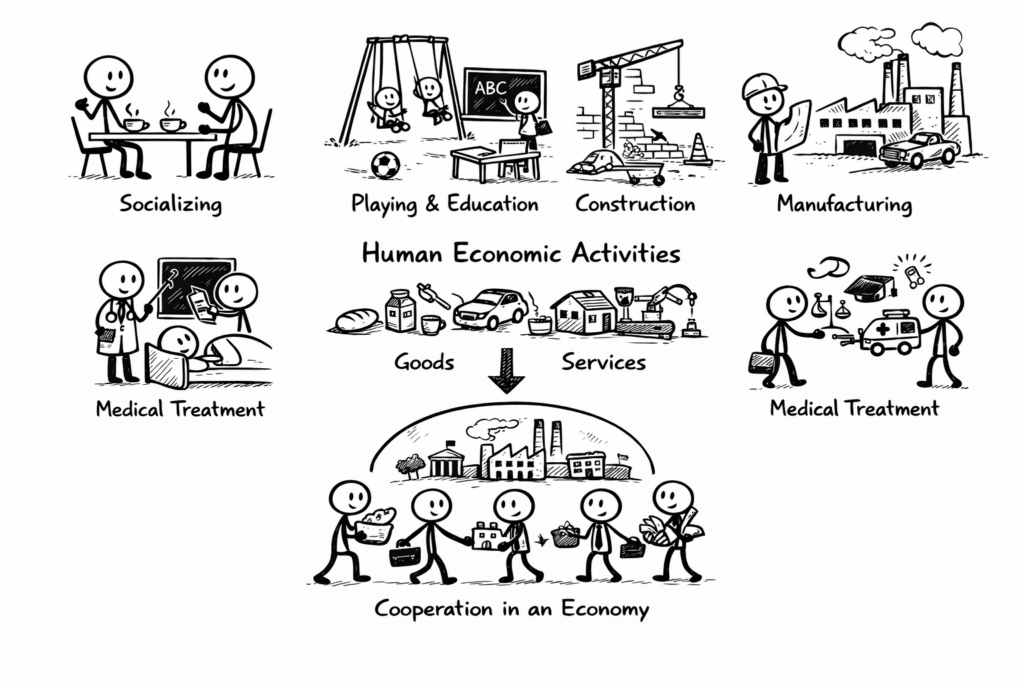
Economic activities
When we look at the world around us, it is clear that humankind is continuously engaged in a multitude of different activities. For example, socialising, playing, going to school, constructing buildings, manufacturing goods in factories, applying medical treatment, investing money, etc.
When all these activities are examined more closely, it appears that the vast majority of human activities are directly or indirectly related to the production of goods and services, also called human economic activities.
The goods that are produced are man-made items with a physical existence, such as food, clothing, houses, books, cars, etc. The services that are produced are useful functions performed by individuals and institutions, such as medical treatment, education and legal advice. Services do not exist in physical form.The reason for human production activities is that goods and services enable people to survive and also enjoy a high standard of living. Over thousands of years, humans have developed to such an extent that they need goods and services and cannot live directly off nature’s gifts like animals do.
Economic cooperation
Early in their existence, humans already realised that an individual on their own cannot produce as many products as when a number of people work together to produce. From prehistoric times to the present day, humans produce the goods and services they want through the cooperation of other people, each contributing a part to production.
People work together in groups (communities) to produce goods and services, because more goods and services can be produced this way than when individuals produce on their own. People who work together in communities to produce goods and services form an economy, for example, the economy of a country, province, city or town.
The concept of “economy” usually refers to the collective and interdependent production activities of people in a country as a whole, called a national economy, for example, the economy of South Africa. One can also refer to the economy of a region, province, city or town. This then involves the collective and interdependent economic activities of the relevant area, for example, the economy of the province of Gauteng. Every economy has specific participants, factors of production and economic processes that contribute to the production of goods and services.
To ensure survival and a high standard of living:
- the goods and services that the community wants must be produced (effective production);
- as many goods and services as possible must be produced with the available factors of production (efficient production); and
- each contributor to production must be compensated according to the extent and importance of their contribution (equitable remuneration).
The study of Economics
The economic problems of WHAT to produce, HOW to produce and FOR WHOM to produce must be solved as effectively, efficiently and equitably as possible to ensure that the types and quantities of goods and services that the community wants are produced at the lowest possible cost and distributed fairly among the contributors to production.
However, this will not happen by itself. To ensure that the economic problems are solved effectively, efficiently and equitably, all the participants, resources and processes involved in the production of goods and services must be studied scientifically.
This scientific study of the economic problems is the task of the discipline of Economics.